5th November 2026 | By Admin
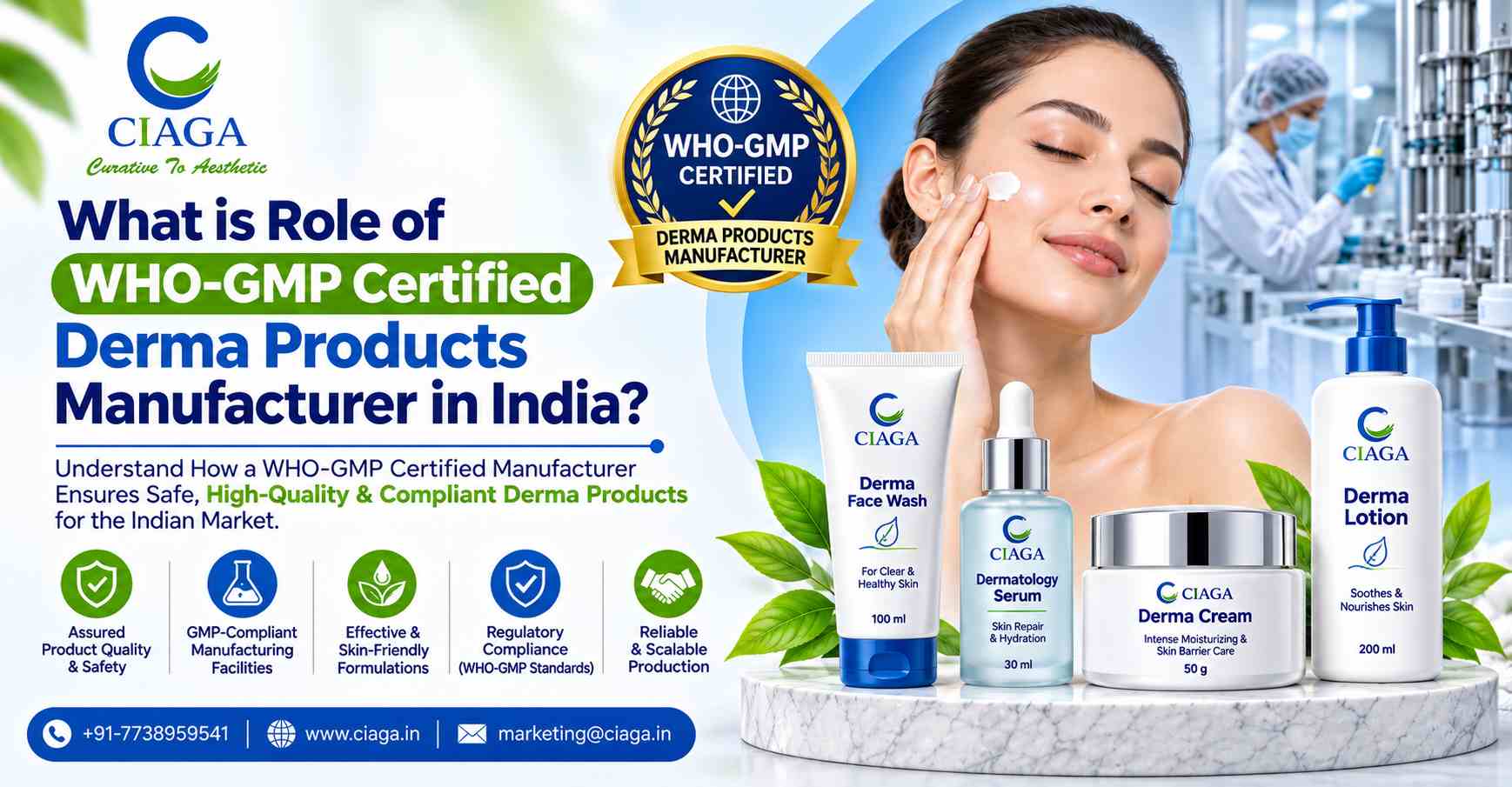
A WHO-GMP certified Derma Products Manufacturer in India goes beyond just packing creams and serums into bottles and tubes. This is the manufacturer which ensures quality, safety and traceability of each item from production until delivery, a thing of high importance for brands who have decided to enter the field of derma products range.
India has become a reliable centre for dermatology and cosmetic formulations, and WHO-GMP certification is the easiest and the best way for buyers to distinguish the right supplier among all others. This guide provides an insight into the meaning of the certification and into how it affects the activity of a WHO-GMP certified Derma Products Manufacturer in India.
What Does a WHO-GMP Certified Derma Products Manufacturer Actually Do?
The task includes formulating a skin preparation and producing a product that meets commercial standards. There is a Derma Products Manufacturer in India that is GMP certified by WHO and operates within the stipulated parameters of Good Manufacturing Practice as per recommendations by World Health Organization. Some of the many aspects that fall under this system include facilities, equipment, qualifications of personnel, raw materials, batches, quality control, complaints, and more.
The Derma Products Manufacturer shall formulate different products daily, such as creams, ointments, gels, lotions, face wash, sunscreens, and serums. The Derma Medicine Manufacturer will formulate each batch with the approved raw materials.
To a brand owner, this process is simply risk management. The more efficient the system, the fewer surprises one gets in relation to the stability, texture, color, fragrance, or even customer complaints. There are many skin product manufacturers that are able to manufacture a good cream, but there are only few skin products manufacturers who can prove it through documentation of each batch being made in the same way.
A small point here: In India, any product claiming therapeutic benefits is normally manufactured under drug license, whereas purely cosmetic products are manufactured under cosmetic regulations. WHO-GMP is a certification above these licenses.
Why WHO-GMP Matters for a Skincare Manufacturer in India?
The skin forms a barrier, and whatever is put on the skin, especially on irritated or sensitized skin, must be free from any contaminants. This is how a reputable Skincare Manufacturer manages the risk:
- Having clearly defined clean areas with limited access to prevent cross-contamination between the products.
- Water systems, as water makes up most creams and lotions.
- Cleaning procedures that have been validated between batches.
- Preservative systems that are validated, not just presumed effective.
- Traceability of the batch that allows the Manufacturer to trace back to and retrieve the batch whenever there is a problem.
These are the reasons why a serious buyer demands proof of an audit trail from a Skincare Manufacturer. GMP certification by WHO has got some level of recognition with importers and distributors in the export market, as they always request it as part of the selection criteria.
Nevertheless, this is only a beginning point since scope, expiry date, and the certifying authority count, and an oral solids certificate does not mean anything for topical products. Be sure to ask what exactly is covered.
Quality Control & Formulation Standards in a Derma Manufacturing Company
A good Derma Manufacturing Company normally segregates the quality department from the production department, as the product release decisions need to be independent. Test procedures are normally carried out in the following manner:
- Testing on the raw materials: Tests for identification and control of actives, emulsifiers, preservatives, packaging material, and water.
- Testing on process control: pH, viscosity, appearance, homogeneity, and fill weights.
- Product testing: Active assay, micro-organism counts, and packaging integrity of the finished product.
Equally critical are stability studies. The same is true for a sunscreen, retinoid cream, or ceramide moisturizer when left open and under climatic conditions like those of coastal Indian cities or hot and dry plains. Keeping of samples and batch manufacturing records enables the team to investigate a customer complaint even months later.
Formulation skills are just as critical as the facilities for the Skin Care Manufacturing Company that deals with actives like niacinamide, salicylic acid, azelaic acid or anti-fungal and anti-acne agents. Compatibility, pH and delivery system determine the efficacy and safety of the product. A good manufacturer reveals his formula to the client rather than keeps it as a black box.
How Derma Third Party Manufacturing Helps New and Growing Brands?
Plant establishment involves massive investment, personnel and approvals. With Derma Third Party Manufacturing, the company does not need to go through such process and instead concentrate on marketing, physicians' interaction and product distribution. This way, the manufacturer creates and packages the product while the brand gets its trademark and the marketplace.
Such an approach is often applied by PCD franchise businesses, startups in the dermatology industry and distributors who wish to have their own line. A competent skincare contract manufacturer should provide:
- Ready formulations and assistance in customization of formula.
- Ability to produce small batches of product.
- Wide choice of packaging options and label approval.
- Batch records that will fit into your quality documentation.
It is necessary to find out who holds the license to manufacture the product and who owns the formula if it is customized for you. All those aspects should be discussed in writing before signing any agreements.
Private Label and Natural Skin Care: Choosing the Right Partner
Private Label Skin Care Manufacturers deliver their ready formulations branded with your company name, thus speeding up the time to market procedure. Custom formulation takes more time, but will give you a unique product. The first method is not necessarily better than the second one, vice versa, it all depends on budget, timeline and the extent of differentiation needed.
When selecting the Best Private Label Skin Care Manufacturers, you should forget about rankings and marketing sites. Consider licenses, quality control laboratory, willingness to perform audits, stability information and customer feedback.
The trend, which affected skin care manufacturers, is increasing use of natural and herbal components. When choosing Natural Skin Care Products Manufacturers, it should be kept in mind that the term “natural” has no universal legal definition. Herbal extracts require standardisation, while the final product still needs to be tested for microorganisms and heavy metals. All statements made on the label of a natural skin care product, such as "dermatologically tested" or "free from," must have a scientific basis.
What to Verify Before Choosing a Derma Products Manufacturer in India?
Apply this simple checklist while vetting your suppliers:
- Current WHO GMP certificate applicable to topical preparations.
- Manufacturing license that has been verified by the respective state regulator.
- Documented Quality Agreement including batch release and complaints procedures.
- Stability and testing data for your product to be launched.
- Clarity on minimum order quantity, lead time, and payment.
- Facility visit or third-party audit before placing your first order.
Brands that do this homework early rarely face recalls or relabelling later.
Frequently Asked Questions
Question 1: Does WHO-GMP certification become a must-have for derma products manufacture in India?
No, that is not always required. The manufacturer must possess the required drug or cosmetic license and be in compliance with the GMP norms in India. WHO-GMP is a separate certification usually asked for export purposes and by quality-conscious brand owners and distributors.
Question 2: What is the difference between a private label and Derma Third Party Manufacturing?
In the case of private label, the manufacturer's formula is used in your product. Third party manufacturing may also involve a formula specifically developed per your requirements, along with specific packaging and labelling and production of the product by the manufacturer itself.
Question 3: How do I verify a WHO-GMP certificate of a manufacturer?
It can be done by requesting a copy of the WHO-GMP certification; verifying the expiry date, applicability and manufacturing license number with the regulatory body of the respective state.
Conclusion
The role of a Derma Products Manufacturer certified by the WHO and GMP standards in India does not end at manufacturing. It helps to protect the consumer in terms of process control, to protect the brand through documentation, and offers distributors and importers an easy benchmark of trust to work with. When deciding between private labelling, custom product development, or even full-scale contract manufacturing, check the certificate, understand the scope, and then evaluate the manufacturer based on its quality systems and not the fancy brochure.
Must Read: Top Derma PCD Franchise Company in Chennai