27th November 2026 | By Admin
Quick Answer: Skin care products manufacturing is a multi-stage process that involves formulation, sourcing of ingredients, testing stability, manufacturing batches, controlling quality and packaging. All these stages have impact on safety, shelf life and brand image. Thus, knowledge of the process will help founders and distributors in choosing a manufacturer.
Skin care products manufacturing is the whole process of producing a safe and stable cream, serum, cleanser or sunscreen from the very idea of the formula. For new brands, dermatologists and distributors, the process determines if the product feels good, has maximum shelf life and satisfies the regulatory requirements.
The majority of quality issues start way before the finished jar of the product and depend on formulation, raw material grades and filling conditions. In this guide, we will cover all stages of manufacturing of the skin care product from development to packaging to help you form better questions to find a reliable Manufacturer for Skincare.
Key Takeaways
Skin care manufacture is an interconnected chain that includes formulation, material procurement, stability and preservation testing, manufacturing, quality control and packaging.
The process of stability and preservation efficacy testing guarantees both safety of skin and shelf life.
Scale-up process requires verification as mixing and cooling will be different on the scale.
GMP (ISO 22716), valid license and batch tracking differentiate reliable partners from unreliable ones.
Demand documents, test reports and a pilot run before bulk purchase.
What is Skin Care Products Manufacturing and How Does It Work?
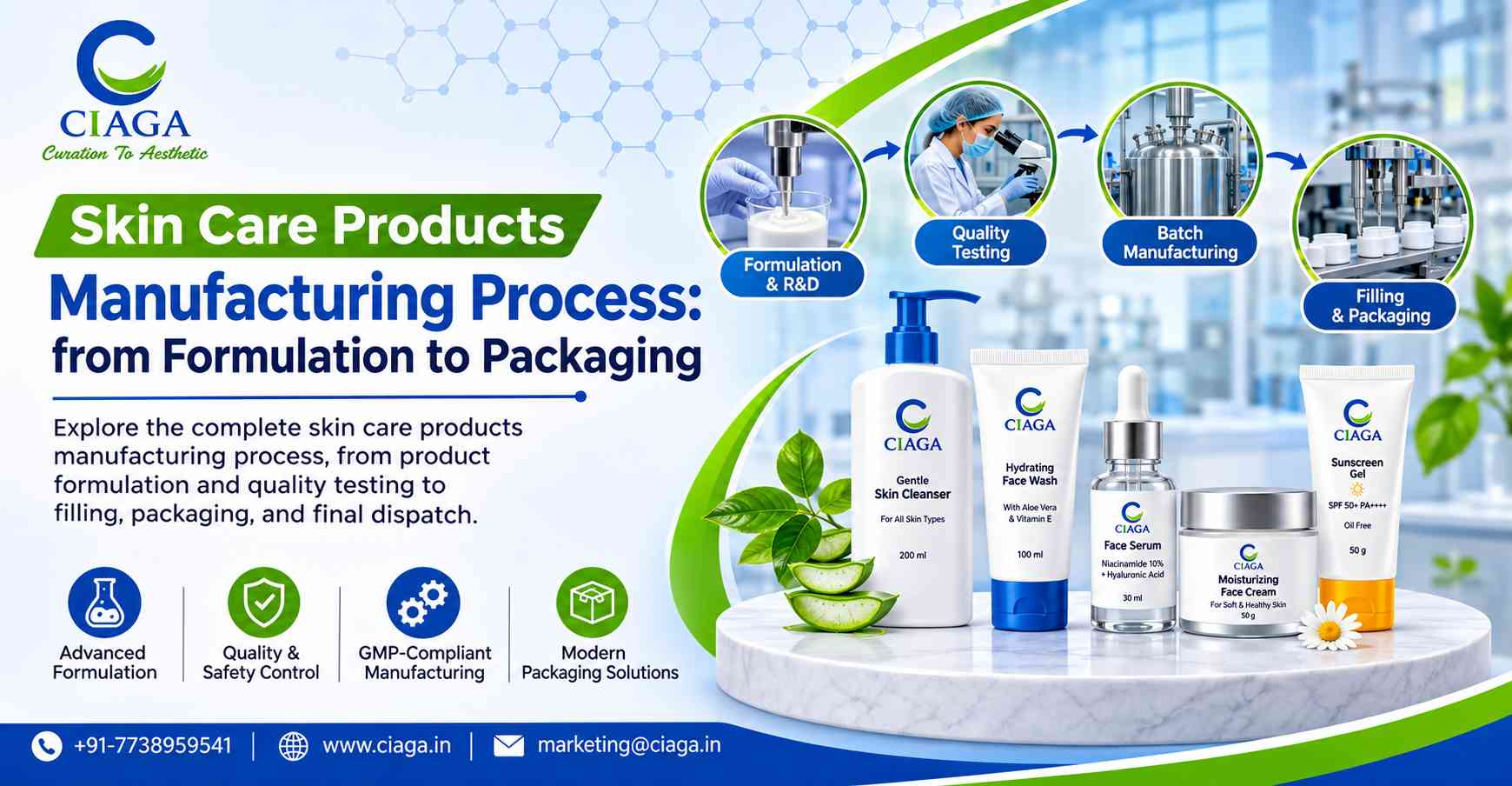
Skin Care Products Manufacturing Process includes all processes from the initial lab formulation to the final product being placed in retail. In reality, it is done in six consecutive phases: formulation, raw material supply, stability and safety testings, batch manufacturing, quality control and packaging with labeling.
In each phase, the output is passed on to the next phase. Formulation that appears to be perfect can separate when it is stored. The perfectly manufactured batch can still end up defective due to interaction with the pump used. This is why the process is always seen as one chain of processes by experienced teams.
For brands, it is important to know that asking the Skin Care Products Manufacturer about documentation for each process and how each phase is signed off, as well as the actions to be taken if the results do not meet specifications.
Formulation: The Foundation Every Skincare Manufacturer Builds On
Formulation is when texture, performance and safety properties are developed. A cosmetic chemist starts from the brief, including the skin type, claims, price point and product form like a gel face wash, a niacinamide serum or a mineral sunscreen.
Then there is the selection of the ingredients. Creams are mostly emulsions, thus the chemist chooses oil phase, a water phase, emulsifiers, humectants, preservatives and active ingredients. Every ingredient has its role, and every ingredient has limitations. Active ingredients should be efficient and non-irritating, the pH should match the active and skin. For instance, vitamin C is most efficient at the lower pH, while some peptides work better at higher pH.
Finally, lab-scale batches are made, typically a few hundred grams. The viscosity, spreadability, odor and look are adjusted. When the sample passes the internal tests, the pilot batch demonstrates how the formula performs on industrial scale equipment.
Brands that collaborate with Private Label Skin Care Manufacturers might be able to select pre-formulated bases and customize them, thus the process is faster. Unique claims require custom development and are more time-consuming but provide a better differentiation.
Raw Material Sourcing and Stability Testing at Skin Products Manufacturers
Quality of the ingredient defines the course of everything that follows. Quality skin products manufacturing companies purchase from selected suppliers and demand a certificate of analysis for every batch, as well as test incoming ingredients before release. Some of the parameters tested include identity, appearance, pH and microbial limits. In case of India, ingredients must also correspond to the BIS specifications like IS 4707 and Cosmetics Rules, 2020.
The stability test addresses an important question of safety and effectiveness of the product throughout its shelf life. The samples are exposed to various storage conditions; 40°C and high humidity is common for accelerated tests while room temperature for real-time tests. The experts observe colour changes, odour changes, phase separation, pH variation and microbial growth.
There are two more important tests. The preservative efficacy test, also known as the challenge test, verifies whether the preservative system is able to control contamination. The compatibility testing verifies that the formula does not react with the packaging material and the pump. Another popular test is dermatological or patch test conducted on volunteers.
Batch Manufacturing and Filling in a Skin Care Manufacturing Company
Following all the approvals, scaling up occurs. A Skin Care Manufacturing Company usually has stainless-steel vessels equipped with homogeniser, heating jacket and agitation.
There is a specific sequence of steps involved in making a batch of emulsion. Firstly, water-phase and oil-phase components are separately heated to about 70-75°C. Secondly, both phases are blended together under high shear. Thirdly, after cooling the batch down, adding heat-sensitive components, such as fragrances and some preservatives, takes place.
Scaling up is much more complicated process than just increasing volumes of components. Mixing speed, heating and cooling rates vary depending on the batch volume, thus changing characteristics of the product. For that reason, manufacturers validate early batches produced for commercial use and document all details in a batch manufacturing record.
Bulk release initiates filling of the containers. It is important to clean and check lines for tubes, jars, pumps and sachets before filling since filling process involves risk of contamination. Operators work in controlled areas with gowning, air handling and clearance of lines between products.
Quality Control and Compliance for a Derma Products Manufacturer
Quality control takes place in conjunction with production, not after the latter. A good Derma Products Manufacturer tests bulk samples of product for pH, viscosity, appearance, aroma and microbial counts prior to approval of fill. For finished products, the testing includes fill weight, seal integrity and labeling accuracy.
Good Manufacturing Practice provides the standards to do this job. ISO 22716 is the international standard that represents GMP for cosmetic manufacturing, encompassing hygiene, documentation, facilities and equipment, complaints and recalls. In India, cosmetics are covered by the Drugs and Cosmetics Act and Cosmetic Rules, 2020. The manufacturer requires a valid license from state licensing authority. Those brands that manufacture for export have to check the laws in the destination country; e.g., MoCRA in the USA or EU cosmetics regulations.
The unsung hero in this story is traceability. Every raw material batch number, batch number and packaging component should be recorded somewhere. When the complaint comes in six months later, the manufacturer knows what caused it.
Packaging and Labelling with Private Label Skin Care Manufacturers
Packaging acts as protection for the formula and the story of the brand. Airless pumps are ideal for formulas that are prone to oxidation. Opaque tubes are recommended for light-sensitive ingredients. The glass packaging is classy but adds weight and risks of breaking during transport.
Package component materials should be scrutinized just like other ingredients. The manufacturers test each bottle, cap and carton that arrives at their facility and ensure that the package does not affect the formula negatively through migration, deformation or deterioration.
Labeling is just as important. The labelling in India for cosmetic products requires such details as name of the product, list of ingredients, content of the product, batch number, manufacturing and expiry details, manufacturing company details and usage instructions. These guidelines may change so check with the manufacturer what is needed.
This is the area where Private Label Skin Care Manufacturers make real contribution. They take care of art work check, batch coding, carton production and dispatch. This allows founders to concentrate on marketing and distribution. Request for proofs and a sample before you approve it.
How to Choose a Skincare Contract Manufacturer in India?
This process works only as well as the partner executing it. In your evaluation of Skin Care Products Manufacturers, do not focus only on cost per unit. Evaluate them for the following:
- Licenses up to date and GMP certified
- Research and Development team with an internal QC lab, not just a third-party tester
- Minimum orders and lead times clear
- Formula licensing agreements, confidentiality clauses and exclusivity conditions
- Will to disclose batch sheets, test results and shelf life studies
The reliable Skincare Contract Manufacturer will be happy about the audit visit and will answer any technical questions straightforwardly. The best private label skincare manufacturers give real timelines, which may vary between several weeks and a few months from inquiry to delivery. They also communicate risks at the stage of planning, not during production.
It is always better to start with the small trial run.
Frequently Asked Questions
Q1. How long does it take for the manufacture of skin care products from formulation to packaging?
It depends on the level of customization involved. Premade formula bases may take four to eight weeks for production, while customized formulas with stability testing and sourcing of packaging can take up to three to six months from initial brief to delivery of the product.
Q2. What is the difference between a contract manufacturer and a private label manufacturer?
In a contract manufacturing scenario, your formula is manufactured as per your own specifications, whereas in a private label manufacturing situation, formulas are already developed by the manufacturer and all you have to do is brand it. Most manufacturers offer both options, so be sure to ask about exclusivity of the formula when negotiating.
Q3. What tests should I ask for prior to the approval of a batch of skincare?
Ask for pH testing, viscosity testing, microbial testing, preservative testing for effectiveness and stability, fill-weight testing, and label testing on final containers. If there are any sensitive skin claims or derma claims, ask for independent dermatological or patch testing from the manufacturer.
Conclusion
Skin care product manufacturing requires patience, documentation and the right partner. Those who know how to formulate, test, produce and package their products make smarter decisions, save money and create more trustworthy products.
At Ciaga Pvt. Ltd, our professionals will help at all stages, starting from formulation and stability testing and ending at manufacturing and packaging under GMP standards. If you need a reliable Manufacturer for Skincare or a manufacturing partner in general, we can assist you in any step of the way. Contact Ciaga Pvt. Ltd. now to receive your samples, formula brief or manufacturing quote.
References:
ISO 22716:2007 – Cosmetics: Good Manufacturing Practices – https://www.iso.org/standard/36437.html
CDSCO – Cosmetics Regulation in India – https://cdsco.gov.in/opencms/opencms/en/Cosmetics/Cosmetics/
U.S. FDA – Modernization of Cosmetics Regulation Act (MoCRA) – https://www.fda.gov/cosmetics/cosmetics-laws-regulations/modernization-cosmetics-regulation-act-2022-mocra